.png)


 Return
|
Ref ID: 3TM2016/2150 | Posted On: 22-06-2017 | Updated on: 22-06-2017
|

|


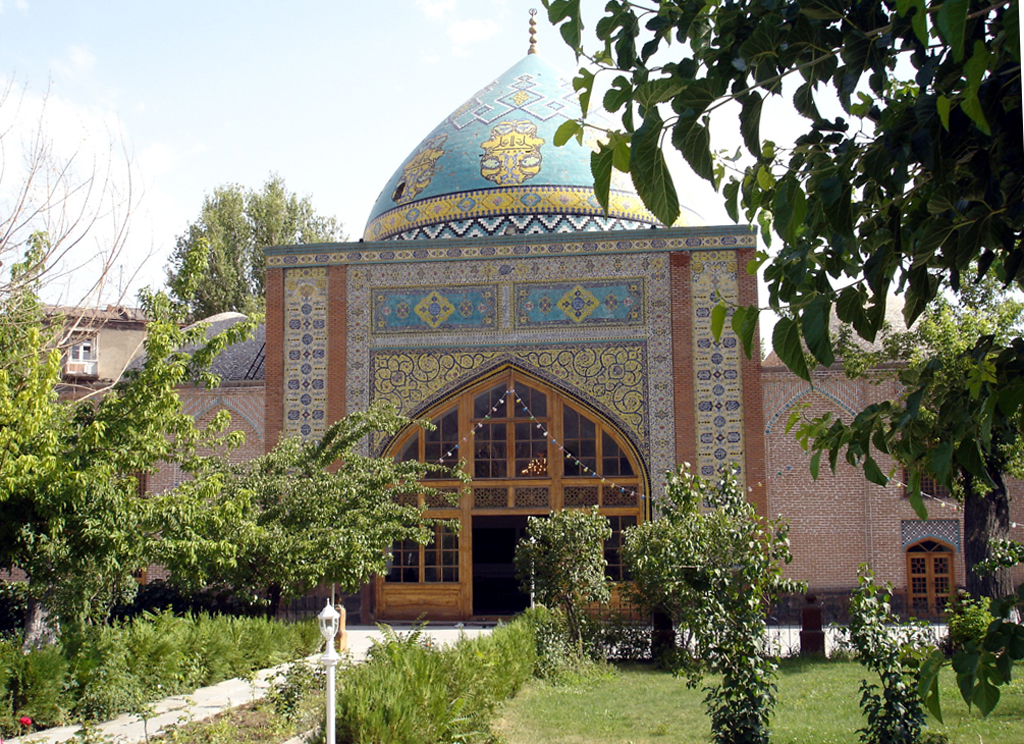
Blue Mosque, Yerevan
| Blue Mosque | |
|---|---|
 |
|
| Basic information | |
| Location | 12 Mashtots Avenue, Yerevan, Armenia |
| Geographic coordinates | 40.1781°N 44.5056°ECoordinates: 40.1781°N 44.5056°E |
| Affiliation | Islam |
| Rite | Twelver Shia |
| Ecclesiastical or organizational status | Mosque |
| Architectural description | |
| Architectural style | Islamic |
| Completed | 1764-68 |
| Specifications | |
| Dome(s) | 1 |
| Minaret(s) | 1 |
| Minaret height | 24 m |

History
Background
The Yerevan region had been under the control of various Muslim rulers since the incursions of Timur in the 14th century. From the early 16th century, and decisively with the 1555 Peace of Amasya, until the course of the 19th century, it had intermittently been a province of Iran (ruled successively by the Safavids, Nadir Shah, Karim Khan Zand and the Iranian Qajar Dynasty), before it fell to neighboring Imperial Russia through the Russo-Persian War of 1826-1828 and the resulting Treaty of Turkmenchay of 1828.[2]
For the mosque's construction, various dates from the mid-18th century are cited in literature. As reported by 19th-century traveller H.F.B. Lynch, the Blue Mosque was commissioned to be built during the reign of Iranian ruler Nadir Shah (1736–47) by Husayn Ali Khan.[3] George Bournoutian names Husayn Ali Khan as the patron of the building, but places his reign in the years 1762-83.[4] According to Vladimir M. Arutyunyan et al. construction started in 1760 and was completed under Husayn Ali Khan in 1764-68.[5][6]
The building was the main congregational mosque for the city. When Yerevan was captured by Russia in 1827 during the 1826-1828 Russo-Persian War it was, according to the cataster drawn up by the Russians, the largest of its eight functioning mosques. The building consisted of the main prayer hall, a library, and a madrasa with 28 cells, all organised around a courtyard, with the overall complex occupying 7,000 square metres of land. There is a single minaret at the main portal, in keeping with contemporaneous mosques, and there is no evidence that there were more minarets.
Soviet era
Due to the secularist policies of the Soviet government, religious services at the Blue Mosque were stopped and in 1931 it was used to house the Museum of the City of Yerevan.[7]
Independent Armenia
In the latter half of the 1990s the mosque underwent a total restoration, funded by Iran, that was completed in 1999. United States Department of State employee and foreign service officer Brady Kiesling referred to the restoration as "structurally necessary but aesthetically ambiguous."[8] The restoration raised concerns among some officials in the Republic of Azerbaijan as the mosque was presented as an Iranian mosque, which in Azerbaijan is claimed as belonging to the heritage of the once large Azerbaijani community of Armenia.[9] Islamic religious services have now resumed within the Blue Mosque, which is the only operating mosque in Armenia. The Museum of the City of Yerevan is now housed in a purpose-built building on another site.
The mosque's ownership was given to Iran in 1995 by the Yerevan city authorities.[10] In December 2015 the Armenian government made a decision to extend Iranian ownership of the mosque for 99 years
government made a decision to extend Iranian ownership of the mosque for 99 years.
Gallery

The Blue Mosque in Yerevan, view from the courtyard towards the prayer hall (photo F. Sarre, 1897)

by Panos Terlemezian, 1917

The "Khan's Mosque" in Yerevan

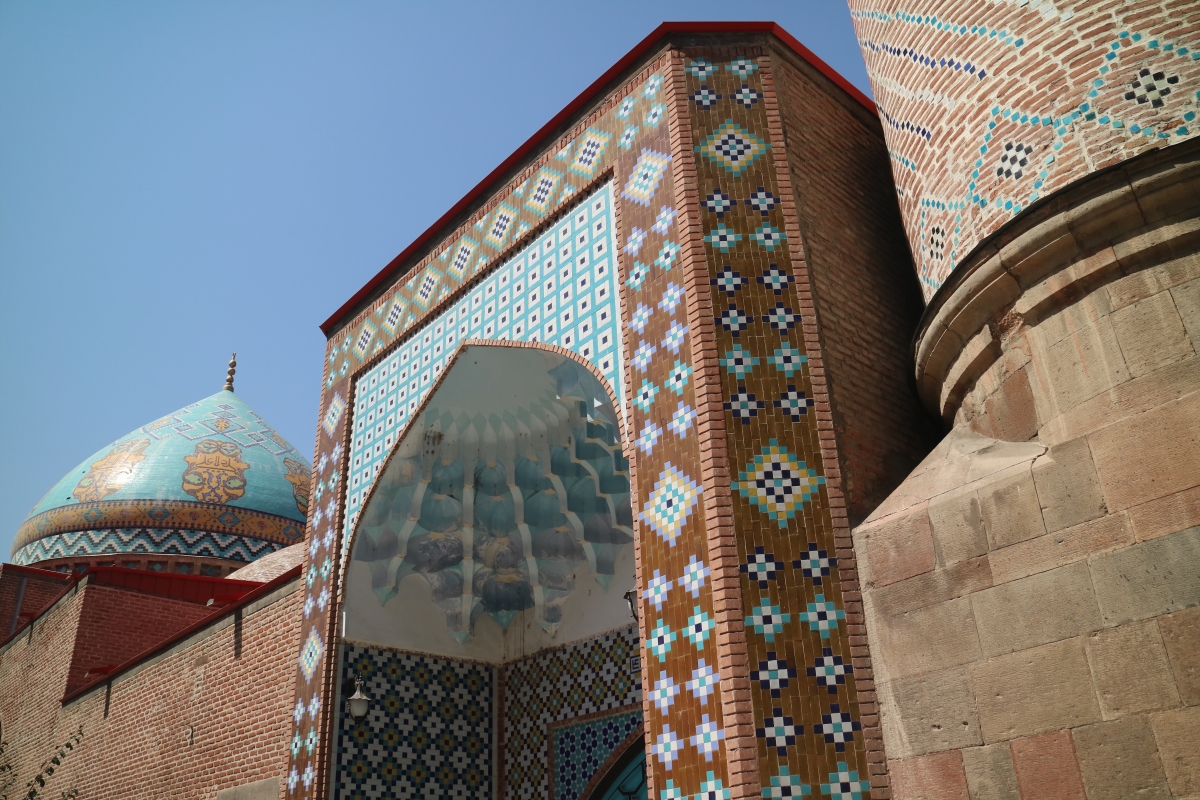
The entrance and the dome

Entrance

Entrance details

Secondary entrance of the Blue Mosque in Yerevan, added in the late 19th century to the original plan

A modern view from the courtyard towards the prayer hall

Minaret of the Blue Mosque

Closer view of the minaret

Closer view of the dome

Interior view of the dome

Interior

Additional Information
Facilities


Contact information



.jpg)